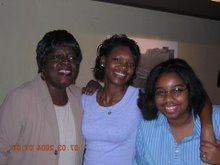
I've spent the last 2 1/2 years of my life hustling against the odds. When you're black, no matter how talented or intellectually driven you may be, obtaining greatness is always a hustle.
I've matriculated through academia, missing family outings, burning the mid-night oil as I've tried to turn a dream into reality. As so many black and brown people are, I'm somewhat of a success token for family members who've been taken aback by my so-called genius.
It's all been hard work mixed with much prayer, sweat, pain, frustration and love. I call myself breaking a curse of ignorance. My ancestors couldn't help the fact that they lacked education. But my wayward cousins have consciously engaged in preposterous lifestyles unknown to me and others.
We all have delinquent family members whose actions serendipitously startle us. We ask ourselves, " How did so-and-so end up like that," or "Why does he/she partake in a lifestyle opposite that of their dedicated, hard-working parents?"
I ponder the answers to these questions as I analyze the psychological well-beings of my cousins. I won't mention their names but their stories are familiar: baby-daddy drama, their children are part of the growing statistic - born in a predominately single parent household, and the last characteristic -- "uneducated".
By no means am I saying I'm perfect. Had it not been for my loving relatives, I wouldn't be in my current position. Even the love from my cousins has sustained me during difficult times.
Still their inability to want more, to see beyond their noises, demeans the efforts of so many young, talented black and brown people. I pray that they wake up from their sleep-walking insomnia and as my aunt Charlotte says, "stop taking wooden nickels."
After all, so many have worked relentlessly to undo a curse that goes unrecognized by my wayward cousins.
Salaam.
E. Tanille
Showing posts with label love. Show all posts
Showing posts with label love. Show all posts
Wednesday, October 24, 2007

Friday, May 11, 2007
No Ordinary Professor
Have you ever had a professor who brought out the best in you?
They push you to excel beyond your expectations. They tell you the truth when it hurts and praise you during pivotal moments. They are the minority among their peers and their uniqueness is a distinguished characteristic. They are no ordinary professors.
I've been blessed to meet one.
I call her Professor Judy - an honorable reference for a beautiful person. I refuse to refer to her as just Judy although that's her name. Professor Judy is my way of saying, "I respect you." I admire her work ethic and strength. She's one of the most intellectually sound professors I know.
I've learned from observing Professor Judy in and outside the classroom. Her advising comments come to mind when I contemplate doubt. I can hear her now, "When you say you're gonna do something, you need to do it." Or "You need to pay meticulous attention to every word." And the most memorable: "Deadlines are important!"
I met Professor Judy during my first year as a journalism student at The University of Iowa. Her class, advance reporting and writing, was the first course I took. Then nervousness trickled through my mind as I questioned my journalistic capabilities. Within weeks, she managed to bring out the best in me, introducing me to strong journalism works that inspired me to think beyond the glass ceiling I was accustomed to.
I'd heard of her uniqueness from other students. Like them, I've grown to cherish this phenomenal professor.
Her works are not the only reason she's exceptional. I could tell you about her tireless efforts to take UI students to Beijing for the 2008 Olympics. Or I could enlighten you with her talented writing and artistic photography. I'm sure you'd be amazed by her research subjects. Her willingness to be a guiding presence to me is what I'm most thankful for.
She never wavered or gave up on me despite my academic tardiness and stubbornness. She pushed me to go beyond my limited expectations. As a result, I knew my last meeting with her would be bittersweet.
I didn't want to say farewell. I'd bought her a card but stumbled to articulate my heart-felt words. I hesitate to personally express my feelings. So I guarded my inner emotions by shortening my conversational reactions. I wanted to tell her thanks and ask why she never gave up on me. I'd hoped to say, "I'm gonna miss you" but I knew that would definitely cause tears.
I didn't cry during our meeting. But as soon as I left her office, the tears came. I thought of the times she encouraged me and said something that generated a sparkle. I wondered why life transitions just when profound people come about.
As usual Professor Judy offered her wisdom to me via e-mail: "You will keep learning in the school of real life, which is not always a great place but a better teacher after all. Stroll with confidence into the next phase of life. Don't ever ever ever sell yourself short."
Although I'm graduating and moving on to life's next journey, I shall never forget Professor Judy. She is no ordinary professor.
Salaam,
E. Tanille
They push you to excel beyond your expectations. They tell you the truth when it hurts and praise you during pivotal moments. They are the minority among their peers and their uniqueness is a distinguished characteristic. They are no ordinary professors.
I've been blessed to meet one.
I call her Professor Judy - an honorable reference for a beautiful person. I refuse to refer to her as just Judy although that's her name. Professor Judy is my way of saying, "I respect you." I admire her work ethic and strength. She's one of the most intellectually sound professors I know.
I've learned from observing Professor Judy in and outside the classroom. Her advising comments come to mind when I contemplate doubt. I can hear her now, "When you say you're gonna do something, you need to do it." Or "You need to pay meticulous attention to every word." And the most memorable: "Deadlines are important!"
I met Professor Judy during my first year as a journalism student at The University of Iowa. Her class, advance reporting and writing, was the first course I took. Then nervousness trickled through my mind as I questioned my journalistic capabilities. Within weeks, she managed to bring out the best in me, introducing me to strong journalism works that inspired me to think beyond the glass ceiling I was accustomed to.
I'd heard of her uniqueness from other students. Like them, I've grown to cherish this phenomenal professor.
Her works are not the only reason she's exceptional. I could tell you about her tireless efforts to take UI students to Beijing for the 2008 Olympics. Or I could enlighten you with her talented writing and artistic photography. I'm sure you'd be amazed by her research subjects. Her willingness to be a guiding presence to me is what I'm most thankful for.
She never wavered or gave up on me despite my academic tardiness and stubbornness. She pushed me to go beyond my limited expectations. As a result, I knew my last meeting with her would be bittersweet.
I didn't want to say farewell. I'd bought her a card but stumbled to articulate my heart-felt words. I hesitate to personally express my feelings. So I guarded my inner emotions by shortening my conversational reactions. I wanted to tell her thanks and ask why she never gave up on me. I'd hoped to say, "I'm gonna miss you" but I knew that would definitely cause tears.
I didn't cry during our meeting. But as soon as I left her office, the tears came. I thought of the times she encouraged me and said something that generated a sparkle. I wondered why life transitions just when profound people come about.
As usual Professor Judy offered her wisdom to me via e-mail: "You will keep learning in the school of real life, which is not always a great place but a better teacher after all. Stroll with confidence into the next phase of life. Don't ever ever ever sell yourself short."
Although I'm graduating and moving on to life's next journey, I shall never forget Professor Judy. She is no ordinary professor.
Salaam,
E. Tanille
Thursday, April 26, 2007
Why I Love Brothas
My love complexities are rooted in blackness and fulfilled by the beautiful essence of brothas. They are the night and shinning physical finesse of urban America. Brothas are the towering giants who helped build this country.
Historical brothas have paid they way for today's brothas. Where would Barack Obama be without Thurgood Marshall? Would Tavis Smiley have been possible had Ed Bradley not existed? And, Dr. Cornel West paved the way for Michael Eric Dyson.
From legendary to present, brothas are a civilized presence that withstands hardships. As the great historian John Hope Franklin said, brothas are often alienated from society - a result of the mainstream's social injustices. Though they are often the subjects of violence and unnecessary brutality, they rise and keep on keeping on. They survive as best they can.
Some hustle on corners; others work menial jobs, sweeping their way from day-to-day trying make a living off minimum rage. I see you brotha; I hear you. Your plight is unbearable for most, but you maintain dignity, strength and courage.
They are the heirs of Malcolm, Martin, Coltrane and Dubois. Without brothas, the inherited culture lessens, communities fade and eventually die.
I get mad when I see brothas with white girls on their arms. It's as if I know their moms. Still, my love for brothas remains. Their hard work, dedication and pride is all I know. My father, brother, cousins, uncles - all the brothas in my life - I love with grace.
Go head on brotha with your business suit and low-trimmed fade. I recognize the baggy pants and cornrolls. I see beyond the bling-bling. All that ice can't hide your troubles and afflictions.
You may be scarred, brotha. Misunderstood by seasoned sistas. But, keep your head to the sky and see what the end will be. You are the soul of a phenomenal culture, supported by sista and brotha hood.
When sistas love brothas, they love a reflection of themselves.
I rise and say with pride: I love brothas!
Salaam,
E. Tanille
Historical brothas have paid they way for today's brothas. Where would Barack Obama be without Thurgood Marshall? Would Tavis Smiley have been possible had Ed Bradley not existed? And, Dr. Cornel West paved the way for Michael Eric Dyson.
From legendary to present, brothas are a civilized presence that withstands hardships. As the great historian John Hope Franklin said, brothas are often alienated from society - a result of the mainstream's social injustices. Though they are often the subjects of violence and unnecessary brutality, they rise and keep on keeping on. They survive as best they can.
Some hustle on corners; others work menial jobs, sweeping their way from day-to-day trying make a living off minimum rage. I see you brotha; I hear you. Your plight is unbearable for most, but you maintain dignity, strength and courage.
They are the heirs of Malcolm, Martin, Coltrane and Dubois. Without brothas, the inherited culture lessens, communities fade and eventually die.
I get mad when I see brothas with white girls on their arms. It's as if I know their moms. Still, my love for brothas remains. Their hard work, dedication and pride is all I know. My father, brother, cousins, uncles - all the brothas in my life - I love with grace.
Go head on brotha with your business suit and low-trimmed fade. I recognize the baggy pants and cornrolls. I see beyond the bling-bling. All that ice can't hide your troubles and afflictions.
You may be scarred, brotha. Misunderstood by seasoned sistas. But, keep your head to the sky and see what the end will be. You are the soul of a phenomenal culture, supported by sista and brotha hood.
When sistas love brothas, they love a reflection of themselves.
I rise and say with pride: I love brothas!
Salaam,
E. Tanille
Saturday, April 14, 2007
The Insurgency of Love
I was watching and reading archive material from "The Tavis Smiley Show," when I came across a February 2007 interview with Dr. Cornel West. Smiley, who has interviewed West on numerous occasions, engaged deeply with the Princeton University professor as they talked one-on-one. In this particular interview, Smiley asked West about the legacy of Dr. Martin Luther King Jr. West referenced King's ideologies . According to West, King's greatness separated him from the status quo. West alluded to his message of love and humanity, forgiving and service, decency and companionship for all. However, West said King was just a man, who depended on many to fulfill his purpose of greatness - eradicating social injustices.
That led me to ask: What does it mean to be great? Some nights, I find myself tossing and turning, repeatedly thinking, "What can I do to better myself and my people's conditions?" According to West, there are two critical things one must do to achieve greatness. One, he said individuals must think for themselves. They must cut against the grain of their peers and develop their own thoughts. Second, individuals must develop their own "habitual vision of greatness." This is, the nagging thoughts, that pull at you, to do more, to be more, in a society dominated by white supremacy, racism and discrimination.
As West poignantly said, "You have to believe in fact that you will refuse to settle for mediocrity. You won't confuse financial security with your personal integrity. You won't confuse your success with your greatness or your prosperity with your magnanimity. If you have a vision of greatness as something that's luring you all the time for something grander than you and, of course, as a Christian, for me, he who is great will be" a servant.
Those who are familiar with Cornel West know that his message is one of faith and love, not hatred. That's why his messages permeate among the masses. Although I had listened to this interview before, his words struck a cord with me again due to a recent class discussion.
As a student, I questioned the statement of a professor, who recently said it was okay for minorities to hate the oppressor. In essence, she said it was okay for the oppressed to hate the oppressor. She referred to white people as the oppressor. I agree that there are certain ills that plague our society, of which people should question and protest against the unjust nature of the status quo. That's what my ancestors did. That's what Martin and Malcolm, Huey P. Newton and Angela Davis did. They protested and fought against a racist society. They did so because they loved the people that they were fighting for.
However, as a Christian and as a product of my ancestors, I believe it is wrong to hate. Hatred is a form of cowardliness and insecurity! For it was the power of love and forgiveness that caused black people to march on Southern domains, consistently agitating for freedom repeated times. It was the power of love and forgiveness that gave my ancestors strength and courage while they were shackled in bondage and treated as chattel, property. Love and forgiveness are the abstract shields that protect me as I traject through a society filled with social ills. I would not be in my current position if my ancestors hated those who hated them. When someone hates you, you must have the power to forgive them, as Nelson Mandela said.
Hate is the one thing that can internally destroy a human being. I find that white radicals (who claim to be down for the cause) are quick to protest using hateful tactics, having had no experience living in blackness. They say "All Power to the People," and preach a message of hate, having not survived years of racism, white supremacy and discrimination like my black brothers and sisters. Their actions are unacceptable and warrant disrespect from myself and other minorities alike.
I hope the professor, who made the comment I referenced, reads this blog. After reading the words of Dr. Cornel West and re-analyzing the thoughts and actions of historical black leaders, she will then see that, "Love and justice is a serious thing in a world that's obsessed with fear, hatred and greed."
Salaam,
E. Tanille
That led me to ask: What does it mean to be great? Some nights, I find myself tossing and turning, repeatedly thinking, "What can I do to better myself and my people's conditions?" According to West, there are two critical things one must do to achieve greatness. One, he said individuals must think for themselves. They must cut against the grain of their peers and develop their own thoughts. Second, individuals must develop their own "habitual vision of greatness." This is, the nagging thoughts, that pull at you, to do more, to be more, in a society dominated by white supremacy, racism and discrimination.
As West poignantly said, "You have to believe in fact that you will refuse to settle for mediocrity. You won't confuse financial security with your personal integrity. You won't confuse your success with your greatness or your prosperity with your magnanimity. If you have a vision of greatness as something that's luring you all the time for something grander than you and, of course, as a Christian, for me, he who is great will be" a servant.
Those who are familiar with Cornel West know that his message is one of faith and love, not hatred. That's why his messages permeate among the masses. Although I had listened to this interview before, his words struck a cord with me again due to a recent class discussion.
As a student, I questioned the statement of a professor, who recently said it was okay for minorities to hate the oppressor. In essence, she said it was okay for the oppressed to hate the oppressor. She referred to white people as the oppressor. I agree that there are certain ills that plague our society, of which people should question and protest against the unjust nature of the status quo. That's what my ancestors did. That's what Martin and Malcolm, Huey P. Newton and Angela Davis did. They protested and fought against a racist society. They did so because they loved the people that they were fighting for.
However, as a Christian and as a product of my ancestors, I believe it is wrong to hate. Hatred is a form of cowardliness and insecurity! For it was the power of love and forgiveness that caused black people to march on Southern domains, consistently agitating for freedom repeated times. It was the power of love and forgiveness that gave my ancestors strength and courage while they were shackled in bondage and treated as chattel, property. Love and forgiveness are the abstract shields that protect me as I traject through a society filled with social ills. I would not be in my current position if my ancestors hated those who hated them. When someone hates you, you must have the power to forgive them, as Nelson Mandela said.
Hate is the one thing that can internally destroy a human being. I find that white radicals (who claim to be down for the cause) are quick to protest using hateful tactics, having had no experience living in blackness. They say "All Power to the People," and preach a message of hate, having not survived years of racism, white supremacy and discrimination like my black brothers and sisters. Their actions are unacceptable and warrant disrespect from myself and other minorities alike.
I hope the professor, who made the comment I referenced, reads this blog. After reading the words of Dr. Cornel West and re-analyzing the thoughts and actions of historical black leaders, she will then see that, "Love and justice is a serious thing in a world that's obsessed with fear, hatred and greed."
Salaam,
E. Tanille
Subscribe to:
Posts (Atom)